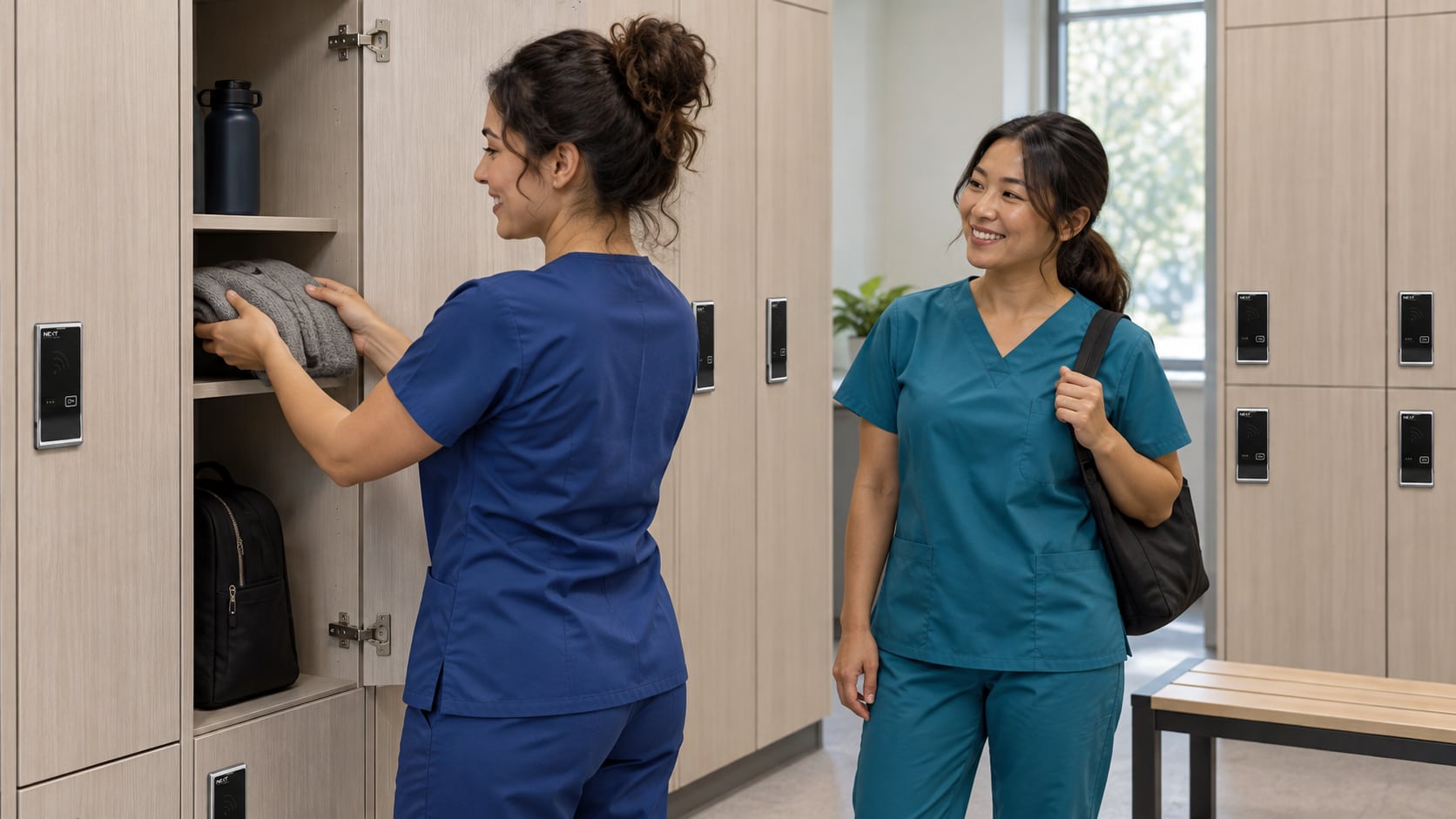
Some electronic locker locks use their own batteries, so they are not powered directly by the building’s electrical supply. That does not mean every credential or management feature will work during every outage. Identify the exact lock, its power source and any network-dependent services, then confirm the expected behavior with the applicable documentation and a planned test.
Separate three different dependencies
A useful continuity plan treats these as separate questions:
- Lock power: what supplies the installed lock itself?
- User access: what does the approved credential need in order to operate?
- Administration: what does staff need to assign users, obtain records or change settings?
A building power failure, an internet interruption and a depleted lock battery are different events. Calling all three “the lock system going down” makes troubleshooting and planning less precise.
Digilock’s documented Axis and Range electronic families use batteries. Their normal lock power therefore should not be confused with a wall-powered controller. Confirm the exact installed version and do not infer that every Digilock product has the same power arrangement.
Do not equate electronic with networked
An electronic keypad does not prove that a lock depends on Wi-Fi, and an RFID reader does not prove that it communicates with the building’s access-control system. Inspect the documented configuration rather than making assumptions from the front interface.
Digilock’s management-planning guidance distinguishes on-site electronic-key management from remote, networked management. It also recommends asking what happens if connectivity is lost. That question belongs in a project specification because the answer depends on the actual system.
Our standalone-versus-connected locker guide explains the broad distinction. For a continuity plan, go further: identify the specific functions the facility expects during an interruption and obtain configuration-specific answers.
Write a simple continuity matrix
List normal user access, authorized assistance, new assignments, credential changes and access-record retrieval. Against each function, record the documented behavior during loss of building power, loss of network service and a lock-power problem. Mark unverified answers as unverified rather than filling gaps with assumptions.
Also record who owns each dependency. Facilities may service the locks, IT may manage the network, and a workplace team may administer assignments. A continuity plan should tell those teams when to involve one another without sharing confidential management credentials in a general document.
Mechanical hardware is a different case. Digilock Mech is mechanical, so electronic battery and network checks do not apply to its ordinary operation. It still needs correct door function and an authorized assistance process.
Test safely with a representative empty locker
Plan a controlled test with facilities, the system administrator and any relevant IT owner. Use an empty, authorized sample opening and agree on the test boundaries beforehand. Do not interrupt a production network, disable a building service or strand users’ belongings merely to explore what happens.
Where a connectivity scenario needs simulation, have the responsible administrator and manufacturer or supplier define a safe method. Record the outcome for each expected function, any limitations and the steps required to return the sample to normal service. This is not a reset or bypass exercise.
Keep maintenance in the plan too. Independent battery power is useful only when the correct batteries are maintained and the matching service guidance is available. Do not assume a battery-powered lock will automatically unlock when batteries are depleted.
Keep the response procedure available
Authorized staff should be able to find model information, approved assistance instructions and support contacts even when the usual online workspace is unavailable. Protect that material according to the site’s credential policy; a publicly posted continuity notice should not expose administrator access details.
Ask about a locker-lock configuration or replacement quote with the family, generation, management method and required continuity behavior. Request clarification of offline functions instead of assuming they follow from the product name.
Power and network questions
Will every battery-powered locker work without internet?
Do not make that blanket assumption. Identify the user credential and management configuration, then confirm which functions are local and which require connectivity.
Is a dead lock battery the same as a building outage?
No. A building outage concerns the facility’s supply; a depleted internal battery concerns the lock’s own power. Their response procedures and dependencies can differ.
Can we test by shutting down the site’s network?
Not as an informal lock check. Use a controlled, authorized test plan that protects other services and users. The responsible IT team should approve any connectivity simulation.
Does a power failure make a locker an emergency exit problem?
These products are being considered for storage openings, not entrances or egress doors. Building life-safety hardware requires a separate specification and qualified review.